The market problem
Rural communities face distance from qualified professionals, fragmented access to consultations, diagnostics and medicines, delayed treatment, travel costs and weak continuity of care.
For investors, incubators & mentors
SwastSaathi is an idea-stage venture. We have no revenue, traction or funding to report yet — what we offer is a clearly defined problem, a partnership-led model and a disciplined plan to validate it through a focused pilot in Bihar.
What still needs to be validated through execution
Rural communities face distance from qualified professionals, fragmented access to consultations, diagnostics and medicines, delayed treatment, travel costs and weak continuity of care.
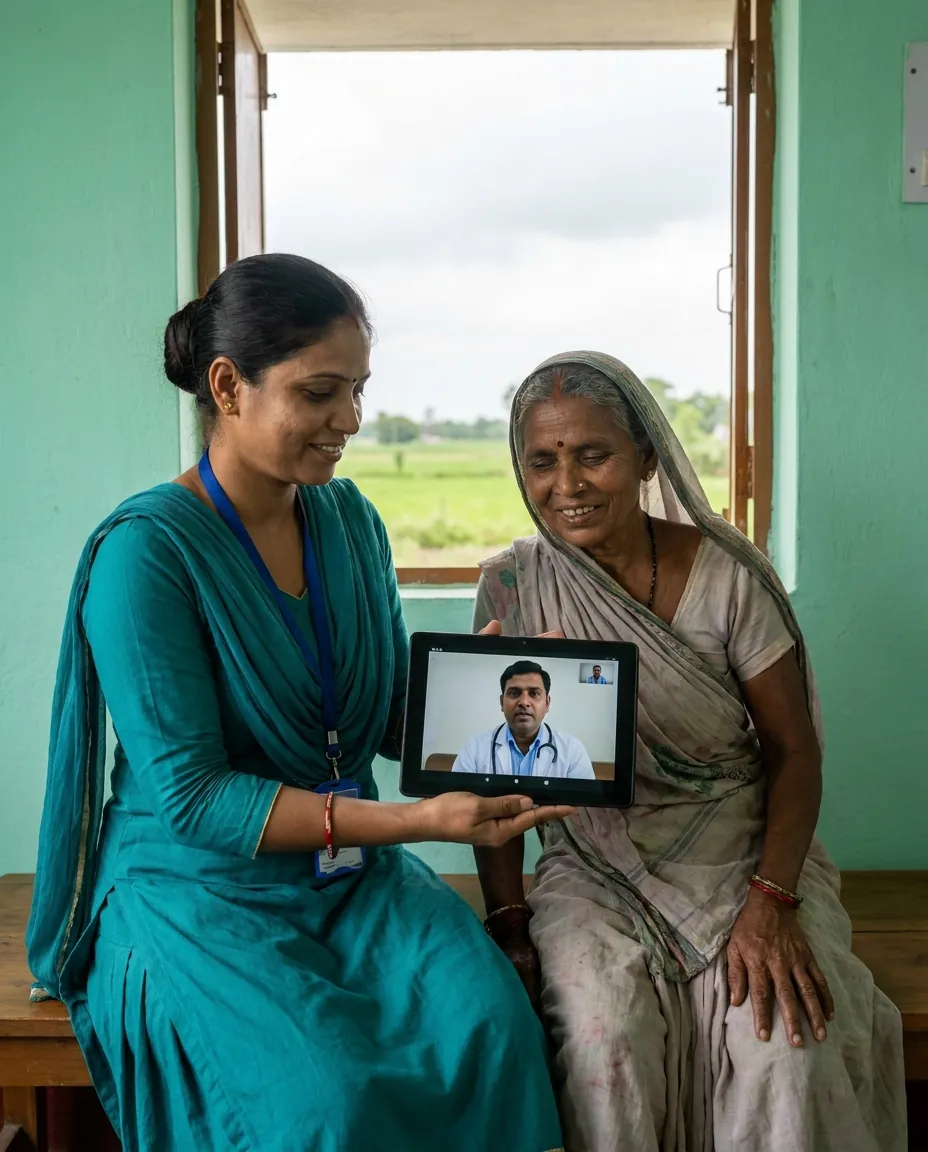
Community healthcare access points, supported by trained workers and digital tools, that coordinate care from licensed doctors, authorised labs, pharmacies and referral hospitals.
Asset-light by design: SwastSaathi coordinates rather than owns clinical capacity, keeping capital focused on access points and technology.
Target customer segments
Families in villages and small towns seeking nearby, affordable primary care.
Patients who need regular monitoring and follow-up close to home.
Doctors, labs, pharmacies and hospitals looking to reach underserved patients.
NGOs, employers, schools and public-health programmes seeking delivery partners.
Potential revenue streams
No financial forecasts are presented. Each stream is subject to applicable regulations, partner agreements and pilot evidence.
01
Modest fees for organising and supporting consultations with licensed doctors.
02
Service arrangements with authorised diagnostic laboratories for coordinated testing.
03
Affordable household plans that bundle coordination and preventive services.
04
Periodic check-up packages designed with qualified healthcare partners.
05
Programmes for NGOs, employers, schools and public-health initiatives.
06
Coordination software and managed services for partner centres over time.
Proposed Bihar pilot
The pilot is intended to test the full patient journey in a focused area of Bihar with a limited number of access points and partners. Location, scale and timing will be confirmed after community discovery and regulatory review.
Key validation milestones
Community discovery: interviews with households and local stakeholders in the pilot area
Provider interest: conversations with doctors, labs and pharmacies on participation terms
Regulatory review: confirm compliance requirements for each coordinated service
Pilot design: site selection, worker training plan and operating procedures
Pricing tests: willingness-to-pay for coordination fees and memberships
Unit economics: evidence on whether a single centre can become sustainable
Risks & mitigation
Risk
Mitigation
Community-led outreach, local workers and transparency about who provides care.
Risk
Mitigation
Simple partnership terms, organised patient flow and clear clinical roles.
Risk
Mitigation
Partnership-led model, licensed providers only, and legal review before launch.
Risk
Mitigation
Small focused pilot, cost discipline and multiple validated revenue streams.
Risk
Mitigation
Low-bandwidth, assisted digital tools with offline-tolerant workflows.
Risk
Mitigation
Standard procedures, worker training, partner verification and periodic review.
If a single centre can be shown to be trusted by its community and sustainable on its own economics, the partnership-led, asset-light design could allow the model to be replicated district by district — using shared technology, standard procedures and local partners rather than heavy capital investment. This thesis is unproven and is precisely what the pilot is designed to test.
Better access to primary care, less avoidable travel and lost income, earlier identification of health risks, improved continuity of care and stronger links between communities and providers — measured through clear indicators once the pilot begins.
Discuss investment or incubation
For early-stage investors, incubators, accelerators, startup competitions and mentors interested in healthcare access in emerging markets.